
Kelles Convenes State, City and Community Partners to Address Accessibility Needs During Route 13 Construction
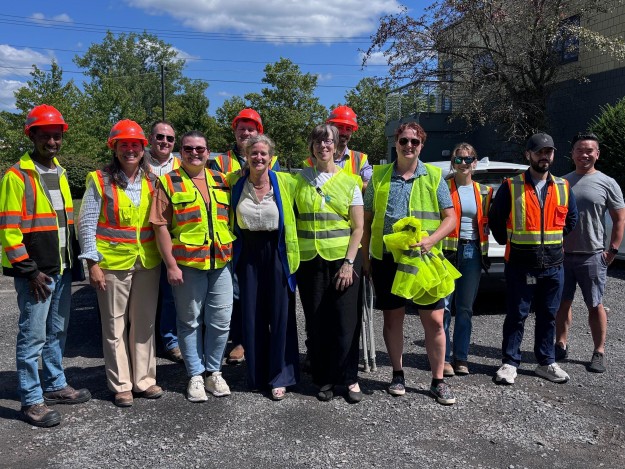
ITHACA, NY - Assemblymember Anna Kelles brought together representatives from the New York State Department of Transportation, the City of Ithaca, Bike Walk Tompkins and the Finger Lakes Independence Center on Friday for a walking tour of the Route 13/Meadow Street corridor.
The group examined barriers created by several overlapping construction projects. Participants also discussed how state agencies, utilities, city contractors, and developers working along the corridor can better coordinate their work to preserve safe passage for pedestrians, bicyclists and people with disabilities.
Kelles organized the walkthrough after residents reported difficulty navigating sidewalks, intersections and crosswalks along the corridor. These conditions have been particularly challenging for people using mobility devices such as walkers and wheelchairs and for people with visual disabilities. Incomplete curb ramps, narrow passages and poorly marked detours can make it difficult or impossible to continue along a sidewalk or reach a designated crossing safely. Families with strollers can encounter many of the same barriers.
Participants included NYSDOT Central New York Regional Director Betsy Parmley, along with members of the department’s regional and engineering staff. Ithaca Mayor Robert Cantelmo and Downtown Alderperson Ducson Nguyen participated, as did staff from the City’s Engineering, Planning and Public Works departments. Bike Walk Tompkins and the Finger Lakes Independence Center brought the perspectives of people who regularly walk, bicycle or use mobility devices along the corridor.
The walkthrough followed an earlier review by City staff that identified several pedestrian safety concerns. In some places, sidewalk closures and detours were not clearly marked. Other locations lacked adequate barriers around construction areas. Participants also identified unfinished curb ramps and intersections where it was difficult to determine how to travel safely through or around the work zone.
NYSDOT subsequently reviewed these locations with its contractor. Additional signs, barricades, cones and other safety measures were installed at several intersections.
On Friday, participants returned to these locations to determine which problems had been corrected and where additional work remained. Disability and transportation advocates demonstrated how the existing conditions affect people traveling through the corridor. This included places where construction materials or incomplete ramps interrupted an accessible route, as well as locations where signs and barricades left too little room for someone using a mobility device.
“Construction will inevitably cause some disruption, but it should not make it impossible or unsafe for someone to get where they need to go,” Kelles said. “A sidewalk closure cannot simply end at a barricade. People need a clearly marked, continuous and accessible route through and around a work zone.”
The group also examined how separately managed projects can unintentionally conflict with one another. Within a relatively short section of the corridor, participants encountered four different projects. The work was being managed separately by NYSDOT, the City of Ithaca, NYSEG and a private housing developer.
Each project has its own contractor, schedule, traffic-control plan and area of responsibility. Residents, however, experience their combined effects as a single construction zone.
Participants discussed the need to review traffic and pedestrian-control plans collectively. A detour created by one contractor can direct people toward another closure. Signs or barriers associated with separate projects can also provide conflicting instructions. This can leave drivers, bicyclists and pedestrians uncertain about where to go and can make a theoretically accessible detour unusable in practice.
“Construction will inevitably cause some disruption, but it should not make it impossible or unsafe for someone to get where they need to go,” Kelles said. “A sidewalk closure cannot simply end at a barricade. People need a clearly marked, continuous and accessible route through and around a work zone.”
The group also examined how separately managed projects can unintentionally conflict with one another. Within a relatively short section of the corridor, participants encountered four different projects. The work was being managed separately by NYSDOT, the City of Ithaca, NYSEG and a private housing developer.
Each project has its own contractor, schedule, traffic-control plan and area of responsibility. Residents, however, experience their combined effects as a single construction zone.
Participants discussed the need to review traffic and pedestrian-control plans collectively. A detour created by one contractor can direct people toward another closure. Signs or barriers associated with separate projects can also provide conflicting instructions. This can leave drivers, bicyclists and pedestrians uncertain about where to go and can make a theoretically accessible detour unusable in practice.
“Written plans and regular communication among government agencies, elected officials, developers and transportation advocates are essential, but they can only take us so far,” Kelles said. “Walking the corridor together added an entirely different level of clarity. Advocates could demonstrate a barrier as they encountered it, engineers and project managers could explain why the conditions existed, and everyone could discuss what needed to change while standing at each planned stop together. This allowed the group to collectively identify solutions in real time, with a shared understanding of how each decision affects movement across the corridor as a whole.”
The discussion also addressed problems that can arise after safety measures are installed. For example, construction signs and barricades may be moved, displaced or removed. Design issues may only become apparent after construction begins. Routes that were accessible during one stage of construction may no longer work when the project enters its next phase. These issues can be prevented when safety measures are reviewed throughout construction, not only when a traffic-control plan is first approved. Regular review and coordination can ensure that signs and protective barriers remain visible, correctly positioned, and understandable. These corrective measures can also ensure that temporary routes provide enough space and an appropriate surface for people using wheelchairs and other mobility devices.
The current NYSDOT project encompasses portions of Meadow and Fulton streets, along with several connecting state routes through Ithaca. The $27.4 million project will resurface the roadway and address cracks, ruts and potholes. It will also replace six traffic signals and upgrade 14 others to improve their operation.
Pedestrian improvements are a significant part of the project. Approximately 15,000 feet of sidewalk will be replaced, and 500 feet of new sidewalk will be added. Curb ramps will be upgraded for accessibility, and a new pedestrian-activated flashing beacon will be installed near Esty Street.
“At the Center for Community Transportation we're always advocating for the safety of pedestrians and cyclists, so it was very positive to get the opportunity to share our community's concerns directly with local and state leadership as the project is underway” said Executive Director Laura Vinyard.
The city has also been replacing approximately 750 feet of water main beneath North Meadow Street between Esty and Hancock streets. This work has required its own sequence of lane and intersection closures. Utility and building development projects have added further construction activity along the corridor.
These investments are all taking place along one of the most heavily traveled corridors in Tompkins County. Route 13 connects people with homes, businesses, schools, jobs and the city’s waterfront. It also carries substantial regional traffic through the center of Ithaca.
For years, local transportation and land-use plans have recognized the need to make Meadow and Fulton streets safer and easier to navigate on foot or by bicycle. These plans have also sought to reduce the degree to which the corridor divides adjacent parts of the city.
“Route 13 is currently essential to regional transportation, but it is also a city street that needs to remain accessible,” Kelles said. “Walking, bicycling and using a mobility device are forms of transportation that our streets, including temporary routes through construction areas, must be designed to accommodate.”
Kelles’ office encourages residents to continue reporting barriers as construction proceeds. These may include inaccessible sidewalks, unsafe crossings, missing or contradictory signs, displaced barricades or other hazards. Conditions can change quickly as projects enter new phases, and precise information about the location and nature of a problem helps direct it to the agency, contractor or developer responsible for correcting it.
Kelles thanked NYSDOT Regional Director Parmley and the department’s staff for their participation, enthusiasm, and expertise. She also thanked Mayor Cantelmo, Alderperson Nguyen, the City’s Engineering, Planning and Public Works staff, Bike Walk Tompkins and the Finger Lakes Independence Center for their continued work to improve safety and accessibility throughout construction.