
|
||

|
Contact: Charles Carrier (518) 455-3888 |
For Immediate Release: July 17, 2001 |
|
Silver, Former Colgate Basketball Star Adonal Foyle Urge Action On Assembly Campaign Finance Reform Package |
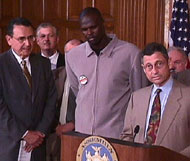
| Assembly Speaker Sheldon Silver today joined Assembly members, government-reform advocates and former Colgate University basketball star Adonal Foyle, now a player for the Golden State Warriors, to urge the Senate and the governor to act on the Assembly's comprehensive campaign finance reform legislation. "The people of New York State must be able to have confidence in the political process and to trust that all of their voices will be heard in election campaigns," Silver said. "This legislation will ensure that elections are decided by ideas and issues, not dollars and cents." The Assembly approved a package of legislation in May of this year that would provide matching public funds to candidates in exchange for tighter controls on campaign spending. It would also expand disclosure requirements and institute other finance regulations for statewide and state legislative campaigns. |
|
 Real Audio Clips from Speaker Sheldon Silver.
"Private money should not drive our political system. Justice, fairness and equal participation - the hallmarks of our democracy - can best be achieved through public financing of elections," said Foyle, who is a 1998 graduate of Colgate University and founder and president of Democracy Matters, an organization formed to give students a voice in the movement for campaign finance reform and to involve them in government and civic affairs. "I speak on behalf of all the Democracy Matters students mobilizing around this issue when I urge the Senate and the governor to act now on campaign finance reform." The Assembly's Campaign Finance Reform Act of 2001 (A.8524) would:
- Provide optional matching funds to candidates in statewide and state legislative races, with participating candidates required to adhere to campaign spending limits and all candidates required to adhere to newly-established contribution limits;
- Limit amounts that can be donated to candidates and political committees;
- Ban soft money contributions to political parties' housekeeping accounts;
- Ban fundraising events by state legislators and statewide candidates within a 40-mile radius of Albany during the legislative session;
- Improve campaign finance reporting procedures;
- Close loopholes that allow corporations to avoid campaign contribution limits by funneling donations through subsidiary companies;
- Require that clear identification of the funding source for communication materials circulated in support of or against candidates; and
- Empower local governments to enact public financing programs for local campaigns.
-30-